Jesus, the King of kings, humbled himself to the point of death on a cross.
The difference between sinful humanity and our perfect saviour couldn’t be greater. One leads to destruction. The other leads to life. May we stop looking to ourselves and instead look to Christ, who gave everything to save sinners like us.
The question of whether Jesus called himself the Son of God is not a trivial matter, as our eternity depends on it. His life, death and resurrection have eternal implications.
The Heidelberg Catechism (Q. 16–17) illustrates the importance of this: Jesus was required to take on human nature because humanity sinned in the flesh. He was also required to be fully God to endure the full extent of God’s wrath. This was necessary to restore life to mankind.
Thanks for reading! Subscribe for free to receive new posts and support my work.Subscribe
If Jesus were only a man, then our hope would collapse (1 Cor. 15:17). Scripture is clear that rejection of Christ brings condemnation and judgement (John 3:18–19) and we remain dead in our sins (Eph. 2:1). Our peace rests entirely on the Son of God.
When Jesus claimed to be the Son of God, he endangered himself. Under Mosaic Law, blasphemy meant death (Lev. 24:16). The Jewish leaders insisted that he must die because of this assertion (John 19:7). In contrast to the religious authorities, when Simon Peter confessed that Jesus was the Son of the living God (Matt. 16:16), Jesus said that he was blessed for this truth was shown to him by the Father in heaven (v. 17). This illustrates the eternal importance of knowing Jesus’s identity.
Claiming God’s Authority
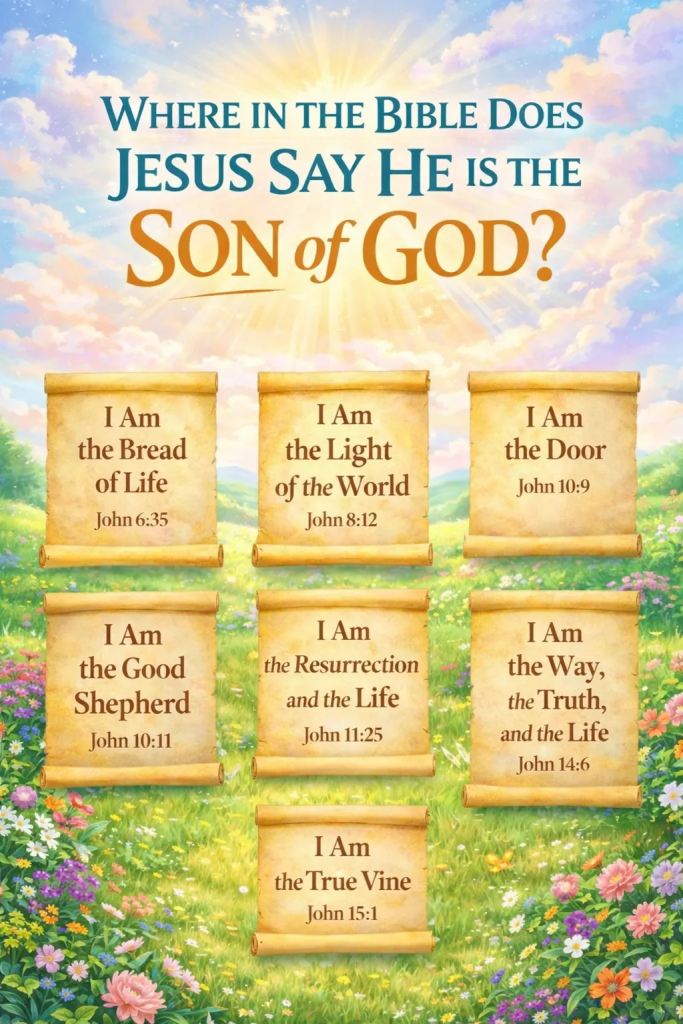
In obedience to God’s command, we observe the Sabbath as a reminder of his magnificent creation (Ex. 20:8–11). When Jesus proclaimed himself Lord of the Sabbath (Matt. 12:8; Luke 6:5), it was not a mere statement, but a sovereign right over creation, displaying his supreme power. Having asserted his cosmic authority, Jesus further demonstrated his divine identity through the seven “I am” statements in John.
These affirmations mirror God’s self-revelation in Exodus 3:14, where God identifies himself as the eternal “I AM”. In declaring the seven “I am” statements, Jesus revealed that the eternal God both speaks and acts with divine power.
He demonstrated his power over salvation by calling himself the bread of life (John 6:35). The Second Helvetic Confession (Chapter 15) clarifies that Jesus feeds us with the gift of faith and therefore offers unity in himself.
Herman Bavinck described this unity as so personal, permanent and pure that words cannot fully capture it.[1] Scripture therefore uses metaphors such as vine and branch to help us grasp the truth.
Jesus is the light of the world (John 8:12). John Calvin expounds that the light of knowing God is found in Jesus, who is the true light and only means of entry.[2] He is the door of the sheep (10:7). He is also the good shepherd (10:11), who lays down his life for his sheep. He is called the resurrection and life (11:25). He is the only one who is the way, the truth and the life (14:6). Calvin warned that those who reject Jesus will be met with God’s wrath and judgement.[3] He is the absolute true vine (15:1).
The Belgic Confession (Article 26) sums this up so perfectly: in light of Jesus being the life, light and only way—he is absolutely everything. No one loves us like he does. The gospel of John was written so that people would “believe that Jesus is the Christ, the Son of God” and that life is offered by belief in his name (John 20:31). This security is encapsulated in Chapter 5:24: those who trust are not judged but pass from death to life.
Authority to Forgive Sins and Grant Salvation
Jesus’s authority over creation extends to his power to forgive sins, showing his divinity in both words and works. He is the King of Kings, who removes trespasses as far as the east is from the west. He is the only way to salvation.
In Mark 2:5–10 Jesus met a paralytic man who was desperate for healing. Jesus called him “son” and forgave his sins. The scribes questioned Christ’s authority to forgive sins, accusing him of blasphemy. According to Old Testament teaching—in Exodus 34:7, Psalm 103:3 and Isaiah 1:18—only God can forgive sins. Jesus not only healed the paralytic, but forgave his sins, thus claiming his status as God and revealing his divinity.
We are reminded of his mercy and faithfulness as our supreme High Priest who is the only one offering salvation and eternal life (Heb. 2:17). We share in him and must not harden our hearts (3:14–15). There is no other way for broken people to be made white as snow.
Romans 1:4 shows that Jesus was declared to be Son of God by his resurrection from the dead and 1 Corinthians 15:17 points out that because he has been raised, we are no longer in our sins. The Second Helvetic Confession (Chapter 11) summarizes this perfectly: he has “purged sin”, and his resurrection has restored immortality.
Bavinck clarified that Jesus was resurrected from death because he completely atoned for humanity’s wickedness.[4]His redemptive work is finished. He is indeed the Son of God! Faith in him secures eternal life (John 3:16). The epistles explain that those who trust are adopted into the Kingdom of God as sons of God (Rom. 8:15, 29). Those who reject him remain in spiritual death and separation (John 8:43–44).
Son of Man Returning in Glory
Jesus also frequently referred to himself as the “Son of Man”, a title that appears around eighty-two times in the New Testament. In Matthew’s gospel the Son of Man suffers under man (17:12) and gave his life to save many (20:28). Our assurance rests in his authority to forgive sins (9:6) because he is raised from the dead (17:9).
His splendor is further revealed when the Son of Man comes on “clouds of heaven with power and great glory” (Matt. 24:30). This echoes the vision in Daniel 7:13–14 where one like the Son of Man comes to the Ancient of Days in the last days. He is granted sovereign reign over an eternal Kingdom and final judgement (John 5:25–27). We can have confidence in the day of the Lord when he comes again to judge the unrighteous.
Son of God Within the Trinitarian Relationship
Jesus confirmed his dominion over creation, the forgiveness of sins and that he will return in glory. His divinity is further secured in the eternal Trinitarian Godhead.
John’s gospel announces the Son’s eternality (John 1:1). Scott Swain explains that the “Word” reveals both his relationship to the Father and his divinity.[5] The Westminster Larger Catechism (Q. 36) proclaims that Jesus is equal with the Father in substance, although a distinct person.
At his baptism, the Father publicly affirmed this relationship, “This is my beloved Son” (Matt. 3:16-17). Francis Turretin concluded on this point that the Son is beloved because of his eternal “Son” status.[6] We have also been commanded to listen to the beloved Son.
Jesus’s repeated references to “My Father” reveal the exclusive and eternal relationship securing his authority, work and divinity (Matt. 11:27). Throughout Church history, some have interpreted the Son of God as lower than God or even a creature. Scripture, however, consistently shows the unity of the three persons—Father, Son and Holy Spirit—with one name (Isa. 43:10–11; Matt. 28:19). This oneness is underscored in Hebrews 1:3 that the Son is the exact imprint of the Father’s nature.
Turretin outlined that Jesus is the uncreated Son of God, eternally begotten, not made.[7] Salvation is the work of the Triune God (Gal. 4:4–7): the Father sent the Son, who completed the work, and the Spirit is sent into believers crying out “Abba Father!” First John 5:11–12 reminds us that eternal life is in him.
Significance of the Son of God
The title of “Son of God” is clearly revealed in Scripture as equal in nature to God. This is why Jesus’s claims provoked such opposition. John’s gospel was written explicitly to prove this identity. Because of this status, salvation comes through him alone.
Jesus acknowledged this eternal identity. He affirmed it when it was confessed and demonstrated through his authority to pardon sins, unity within the Trinity and fulfillment of the “Son of Man” prophecy.
While Jesus not only proved his title of Son of God implicitly through his life, death and resurrection from the dead, he also declared it explicitly with his words. His identity is the crux of the gospel: as the eternal Son, his perfect completed atoning work alone offers salvation. Calvin sums up that Jesus is the Son of God by nature, in comparison to believers whose adoption as sons of God is a gift.[8] And what a glorious gift indeed!
As we reflect on the upcoming Easter season and meditate on the death and resurrection of the Son of God, we are increasingly aware of his majesty and his divinity and therefore the salvation that he offers. His crucifixion marked the culmination of his earthly ministry, yet his resurrection from the dead vindicates his claims. In the Son of God, death has lost its sting because he conquered death and revealed himself to be the only way to eternal life.
The living Son of God offers salvation to all who believe. This invitation comes through “Scripture alone” Sola Scripturain “Christ alone” Solus Christus through “faith alone” Sola Fideby “grace alone” Sola Gratia for the “glory of God alone”Soli Deo Gloria. The gospel is the only true comfort for sinners.
End Notes
[1] Herman Bavinck, Reformed Dogmatics, Vol. 4, ed. John Bolt, trans. John Vriend (Grand Rapids, MI: Baker Academic, 2008), 577, https://www.perlego.com/book/2051292.
2 John Calvin, Institutes of the Christian Religion, trans. Robert White (Edinburgh, UK: The Banner of Truth Trust, 2020), 207.
3 Calvin, Institutes of the Christian Religion, 527.
4 Bavinck, Reformed Dogmatics, 217.
5 Scott R. Swain, The Trinity: An Introduction (Wheaton, IL; Crossway, 2020), 78.
6 Francis Turretin, Institutes of Elenctic Theology, Vol. 1: First Through Tenth Topics, ed. Jr James T. Dennison, trans. George Musgrave Giger (Phillipsburg, New Jersey: P & R Publishing, 1992), 301.
7 Turretin, Institutes of Elenctic Theology, Vol. 1, 185.
8 Calvin, Institutes of the Christian Religion, 236.